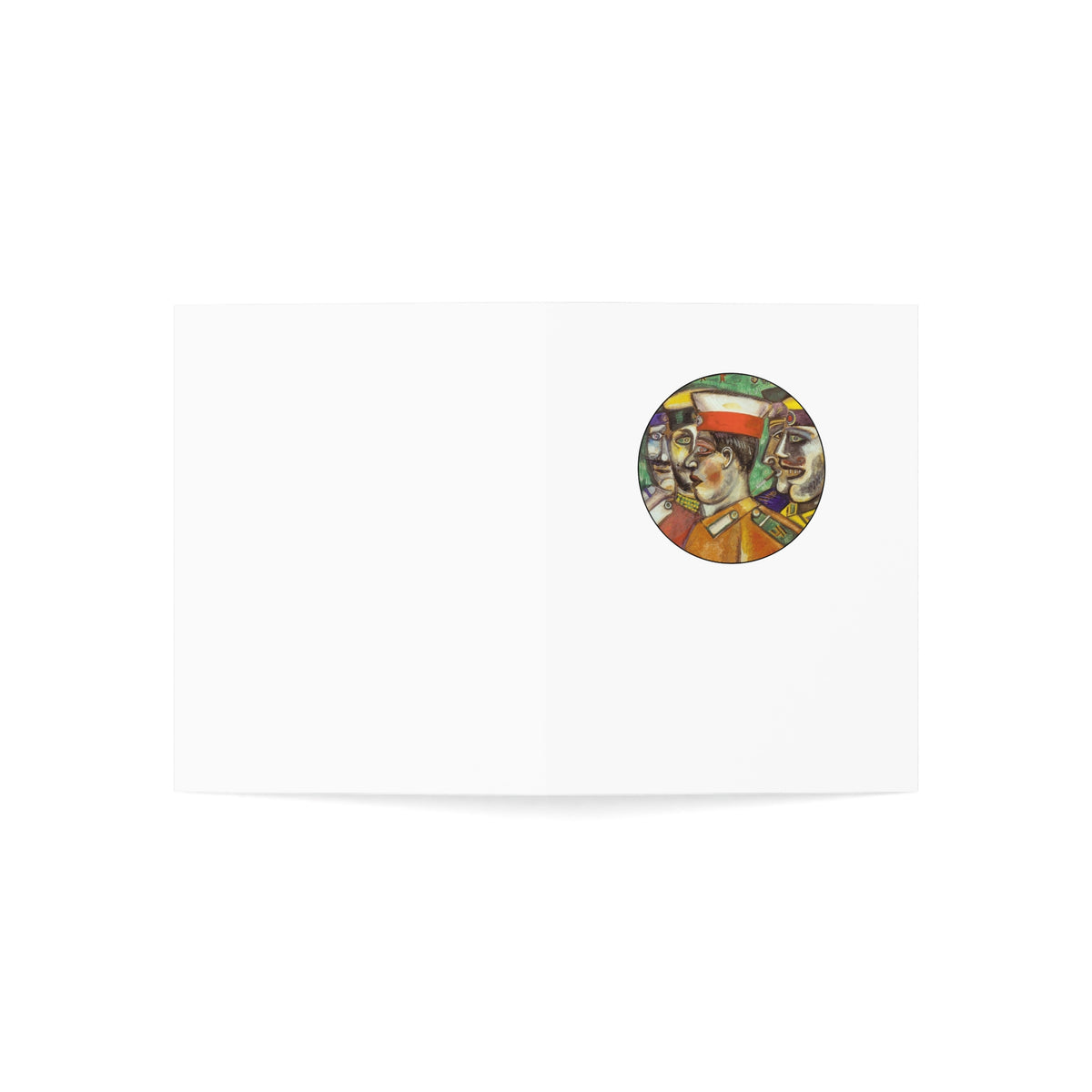
Marc Chagall Soldiers Portrait Premium Notecards | Art History Gift
Marc Chagall Soldiers Portrait Premium Notecards | Art History Gift
Couldn't load pickup availability
Share
The Face Behind the Name
The Face Behind the Name
Marc Chagall (1887–1985) made paintings that bring memory, music and storytelling into dreamlike worlds. Born in Vitebsk, in what is now Belarus, he drew on the Jewish communities and traditions of his childhood while developing an imaginative visual language all his own. Soldiers and other figures from a troubled century entered that world alongside lovers, animals and musicians.
Marc Chagall's work refuses easy boundaries between memory, dream and history. Born in Vitebsk, in what was then the Russian Empire, he grew up amid Jewish traditions that remained central to his imagination. After studying art and encountering the Parisian avant-garde, he developed pictures in which human figures float, familiar places become strange and emotional relationships disrupt ordinary space. Wartime upheaval and displacement affected his life across Europe, informing art that can feel joyful and haunted at once.
An image entitled Soldiers requires careful interpretation: no single title or scene can convey Chagall’s full visual language. More broadly, Chagall's soldiers and other figures of conflict can be approached through his recurring concerns with exile, belonging and fragile community. His paintings rarely behave like literal illustrations of events. Instead, color and imaginative distortion communicate experiences that straightforward documentary detail may miss. The personal and historical coexist in images that seem to exist both inside and outside time.
Chagall lived through revolution, war and exile, yet his art rarely reads like a straightforward historical report. Instead, familiar scenes can seem to float outside ordinary time and space. His paintings invite viewers to consider how personal memory survives the upheavals of history.
A painting connected to soldiers can invite immediate assumptions about battle, victory or defeat, but Chagall's dreamlike visual language encourages a slower response. Before asserting an exact narrative, the image must be identified. Once it is, the richer questions concern memory and the private emotions that war awakens. The person behind the painting created a world in which history is felt rather than merely illustrated.
Product Details & Care Instructions
Product Details & Care Instructions
Product Details
- Pack of 10 folded greeting cards with envelopes included
- Four sizes: 4.25" x 5.5", 5" x 7", 5.25" x 5.25" square and 5.5" x 8.5"
- Coated silk paper with a glossy protective finish
- Premium heavyweight 350 gsm paper for a substantial feel
- Vibrant, digitally printed colors with crisp detail
- Blank inside and back, ready for your own message
- Original WITS circular portrait artwork on the front
- Printed to order
Care Instructions
- Use a soft, clean and dry cloth to gently brush any dust or dirt off from the center of the card outwards.
A Note About Product Images
A Note About Product Images
Our product images include AI-generated lifestyle scenes and digital product mockups intended to illustrate how each item may look. While we strive to represent our designs, artwork placement, colors and product details accurately, the actual manufactured product may vary slightly from the images shown.