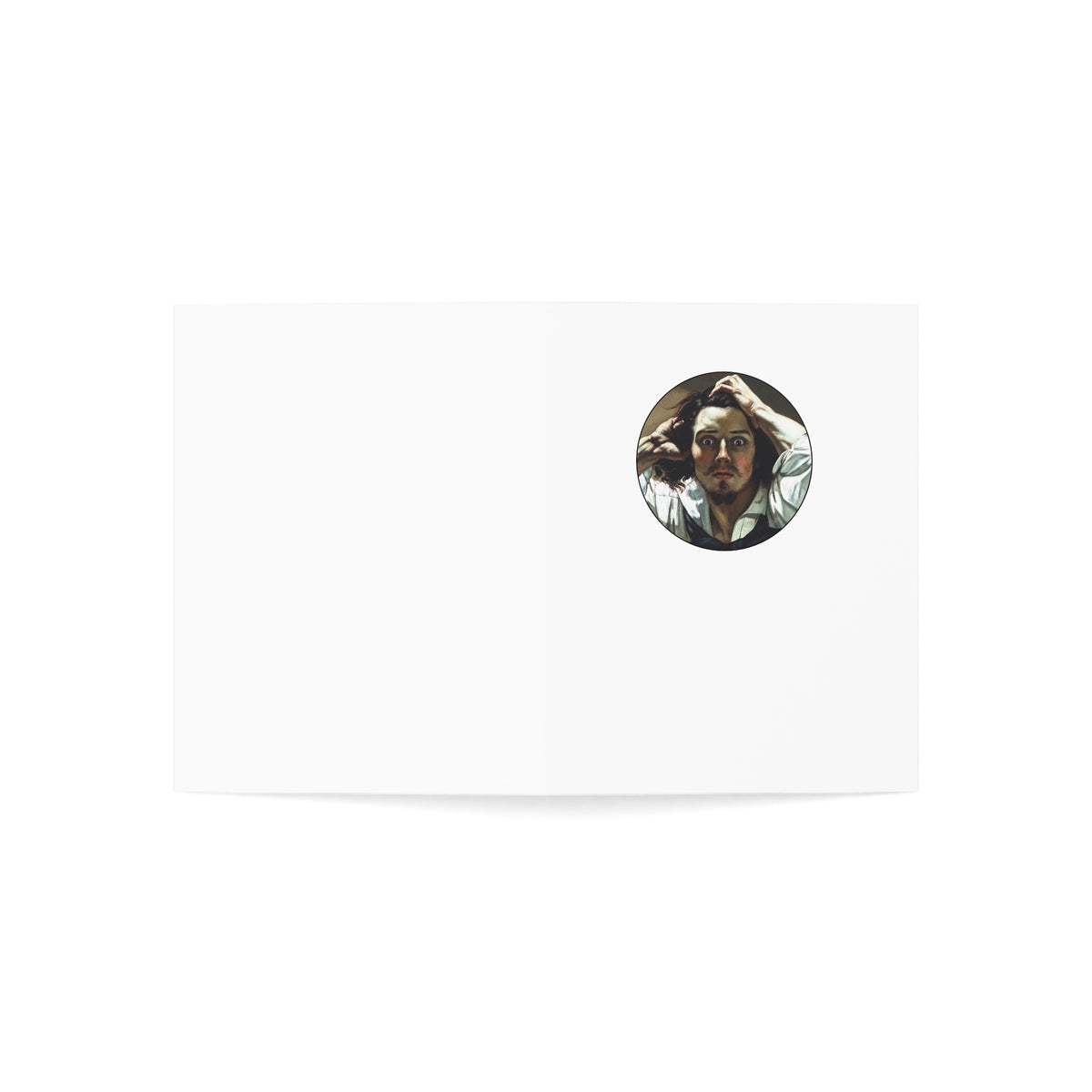
Gustave Courbet Portrait Premium Notecards | Realist Art History Gift
Gustave Courbet Portrait Premium Notecards | Realist Art History Gift
Couldn't load pickup availability
Share
The Face Behind the Name
The Face Behind the Name
Gustave Courbet's The Desperate Man, painted around 1844–45, is an arresting self-portrait of the young French artist. He clutches his hair and stares outward with wide eyes, while dramatic lighting intensifies the sense of sudden emotion. The expression still feels startlingly immediate nearly two centuries later.
Courbet's The Desperate Man presents the artist at close range, eyes wide and hands gripping his hair in a theatrical expression of alarm. Painted in the 1840s, the self-portrait seems startlingly immediate to contemporary viewers. Courbet went on to become a central figure in French Realism, arguing that painting should confront the tangible world rather than rely exclusively on idealized historical or mythological subjects. His artistic choices often provoked hostility from institutions and critics.
The early self-portrait is not a literal record of a single documented crisis. Its exaggerated expression demonstrates Courbet's interest in staging emotion and challenging expectations about respectable portraiture. Later works such as A Burial at Ornans gave ordinary modern life the scale usually reserved for grand historical scenes. Courbet's political involvement in the Paris Commune added further controversy to his career and contributed to his later exile. The face in The Desperate Man feels unforgettable because it catches a young artist experimenting with identity, ambition and the power of direct confrontation.
Courbet later became a central figure in Realism, rejecting idealized academic conventions in favor of subjects drawn from contemporary life. This early work shows his willingness to experiment with self-image and emotional intensity. Long before the age of the selfie, he understood the power of a face confronting the viewer.
Courbet seems almost to burst out of the picture, confronting the viewer with a theatrical intensity unusual for formal portraiture. That effect is a deliberate artistic choice, not proof of a particular crisis in his life. The modern appeal of the work lies partly in this ambiguity. A face painted nearly two centuries ago can still look startlingly close to the emotional vocabulary of the present.
Product Details & Care Instructions
Product Details & Care Instructions
Product Details
- Pack of 10 folded greeting cards with envelopes included
- Four sizes: 4.25" x 5.5", 5" x 7", 5.25" x 5.25" square and 5.5" x 8.5"
- Coated silk paper with a glossy protective finish
- Premium heavyweight 350 gsm paper for a substantial feel
- Vibrant, digitally printed colors with crisp detail
- Blank inside and back, ready for your own message
- Original WITS circular portrait artwork on the front
- Printed to order
Care Instructions
- Use a soft, clean and dry cloth to gently brush any dust or dirt off from the center of the card outwards.
A Note About Product Images
A Note About Product Images
Our product images include AI-generated lifestyle scenes and digital product mockups intended to illustrate how each item may look. While we strive to represent our designs, artwork placement, colors and product details accurately, the actual manufactured product may vary slightly from the images shown.