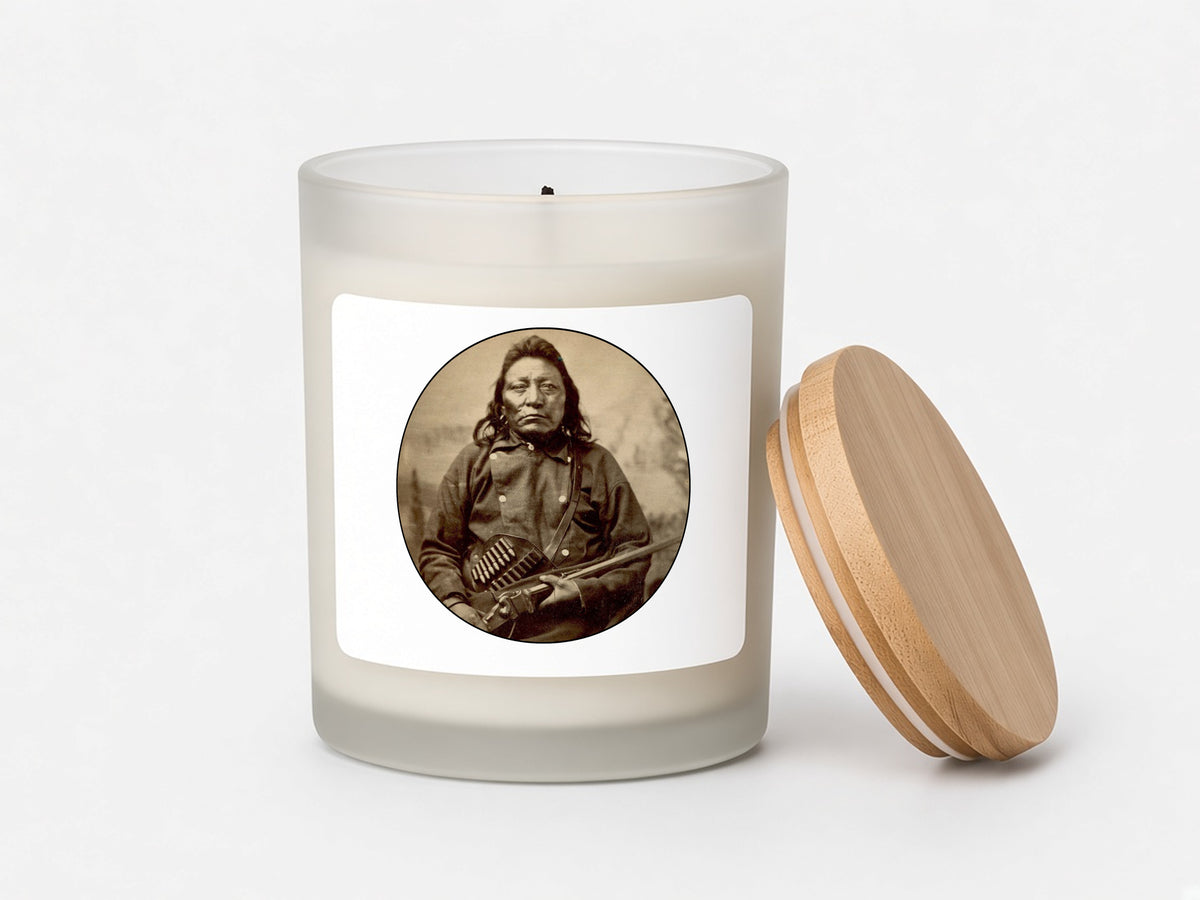
Crazy Horse Scented Candle | Lakota And American West History Gift
Crazy Horse Scented Candle | Lakota And American West History Gift
Couldn't load pickup availability
Share
The Face Behind the Name
The Face Behind the Name
Crazy Horse (c. 1840–1877) was an Oglala Lakota leader whose resistance to U.S. expansion made him a central figure in the history of the northern Great Plains. He fought to defend Indigenous lands and was associated with the Lakota and Cheyenne victory at the Battle of the Little Bighorn in 1876.
Crazy Horse, an Oglala Lakota leader, remains one of the most consequential figures in Indigenous resistance to U.S. expansion on the northern Plains. His life unfolded amid increasing military pressure, treaty violations and conflict over lands central to Lakota communities. Accounts of his leadership emphasize courage, tactical skill and a relatively reserved public manner. He was closely associated with resistance campaigns that culminated in the Battle of the Little Bighorn in 1876, where Lakota and Cheyenne forces defeated troops under George Armstrong Custer.
After continued fighting, Crazy Horse surrendered in 1877 and died during an attempted confinement by U.S. authorities. The circumstances remain painful and contested in historical memory. Much of what is known about him comes from oral histories and later testimony, which deserve attention to their distinct perspectives. Crucially, no photograph of Crazy Horse is generally accepted as authentic; commercial images bearing his name often depict an imagined likeness or another person. A responsible biography honors the leader without pretending that his exact face is established by surviving photography.
Crazy Horse died in 1877 while in U.S. military custody. No photograph of him is generally accepted as authentic, so images presented as his likeness should be understood as artistic interpretations rather than verified portraits. His significance rests in the historical and oral traditions that preserve his leadership.
The absence of a verified photograph of Crazy Horse is not a minor cataloging problem. It challenges a culture accustomed to attaching a definitive face to every famous name. Lakota memory, oral testimony and historical context convey a legacy that an imagined portrait cannot authenticate. His life deserves careful representation on its own terms, including respect for the histories through which his people remember him.
Product Details & Care Instructions
Product Details & Care Instructions
Portrait candle with a historical design on the vessel. Available sizes and fragrances are displayed in the product options. Candle materials, container style and burn time vary by fulfillment model.
Candle Care & Safety
- Trim the wick to approximately 1/4 inch before lighting.
- Burn on a level, heat-resistant surface, away from drafts and flammable objects.
- Never leave a burning candle unattended. Keep away from children and pets.
- Allow wax to cool completely before moving the container.
- Stop burning when approximately 1/2 inch of wax remains.
A Note About Product Images
A Note About Product Images
Our product images include AI-generated lifestyle scenes and digital product mockups intended to illustrate how each item may look. While we strive to represent our designs, artwork placement, colors and product details accurately, the actual manufactured product may vary slightly from the images shown.