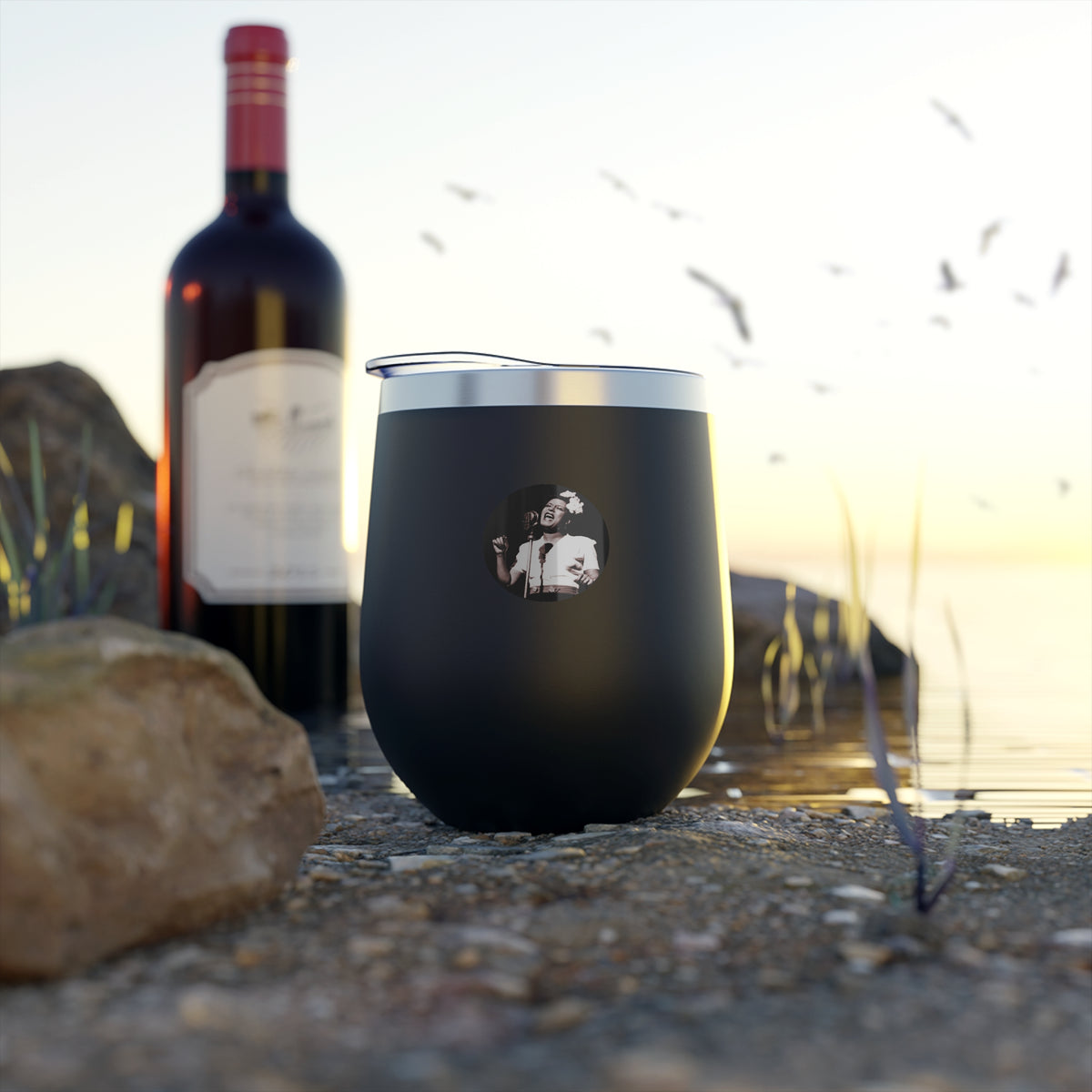
Billie Holiday 12 oz Insulated Wine Tumbler | American Jazz History Gift
Billie Holiday 12 oz Insulated Wine Tumbler | American Jazz History Gift
Couldn't load pickup availability
Share
The Face Behind the Name
The Face Behind the Name
Billie Holiday (1915–1959), affectionately known as “Lady Day,” possessed one of the most distinctive voices in American music. She was not celebrated for extraordinary vocal range or technical flourishes. Her genius lay in something more elusive: the ability to make a familiar song sound as though she were revealing a deeply personal secret.
Born Eleanora Fagan in Philadelphia on April 7, 1915, Holiday spent much of her childhood in Baltimore, Maryland. Her early years were marked by poverty and instability, but music offered an escape. She listened intently to recordings by Louis Armstrong and Bessie Smith, absorbing the phrasing, emotional expression and improvisational freedom that would become hallmarks of her own singing.
After moving to New York, she began performing in Harlem nightclubs. In 1933, producer John Hammond arranged her first recording session with Benny Goodman. Her career soon flourished through collaborations with pianist Teddy Wilson and saxophonist Lester Young, whose musical partnership with Holiday became legendary. Young gave her the nickname “Lady Day,” while she affectionately called him “Prez.”
Unlike many singers of her generation, Holiday treated the melody as a starting point rather than a rigid structure. She could sing behind the beat, stretch a phrase or change a song's emotional meaning with the slightest alteration in timing. Her recordings with Count Basie and her appearances with Artie Shaw helped establish her as a major star during the swing era.
In 1939, Holiday introduced “Strange Fruit” at New York's Café Society. Written by Abel Meeropol, the song confronted the lynching of African Americans with unflinching imagery. Her haunting interpretation became one of the most significant protest recordings in American history. Other enduring performances included “God Bless the Child,” “Lover Man” and “Don't Explain.”
Holiday's personal life was often turbulent. Racial discrimination, abusive relationships, addiction and legal troubles complicated a career of extraordinary artistic achievement. Yet even as her voice grew rougher in later years, its emotional power remained unmistakable. Her 1956 autobiography, Lady Sings the Blues, introduced her remarkable and troubled life to an even wider audience.
Billie Holiday died in New York on July 17, 1959, at just 44 years old. Her influence remains immeasurable. Generations of jazz, blues, soul and popular singers have drawn inspiration from her phrasing and emotional honesty. More than six decades after her death, Lady Day remains proof that the greatest singers do not merely perform a song. They inhabit it.
Product Details & Care Instructions
Product Details & Care Instructions
Product Specifications
- 12 oz (0.35 L) size with a clear push-on lid
- Double-wall insulation keeps beverages warm for up to 6 hours or cold for up to 24 hours
- No-sweat exterior prevents condensation from forming on the outside
- Durable stainless steel resists rust, stains, and corrosion
- BPA-free construction with a durable powder-sprayed color finish
- Available in Black or White
Care Instructions
- Hand wash only
A Note About Product Images
A Note About Product Images
Our product images include AI-generated lifestyle scenes and digital product mockups intended to illustrate how each item may look. While we strive to represent our designs, artwork placement, colors and product details accurately, the actual manufactured product may vary slightly from the images shown.